

‘Everything is an Essay’
on graduating from grad school and ‘owning my prose’

I am finally coming up for a long anticipated gulp of air after two years of deep immersion in graduate school. Between tutoring and teaching, taking 3 classes a semester, working on my thesis, reading hundreds of pages, grading hundreds of pages, driving back and forth from my apartment to the little university by the sea, I let this space collect digital dust. But I didn’t stop writing.
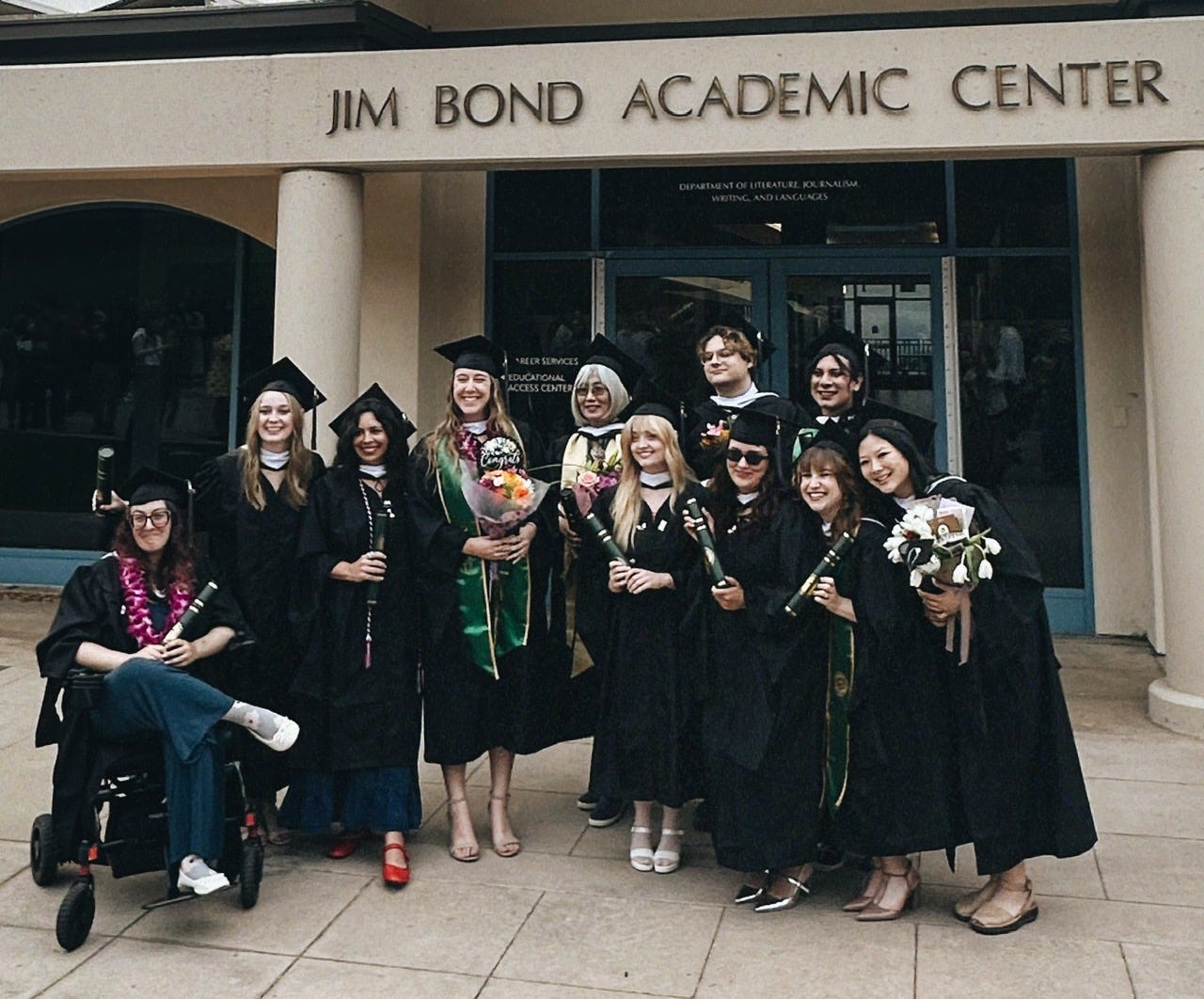
In fact, over the past two years, I have written more than I have ever written in my life—likely hundreds of thousands of words when you include reading responses, craft essays, lesson plans, student comments, workshop letters, research papers, scripts, poems, and essays. Ten days ago, I crossed a stage beneath a May gray sky, shook the president’s hand, and received the physical proof of two exhausting, wonderful years: a Masters of Arts degree in Writing.
Two years ago, I applied on a whim, though I’d been seriously considering and researching graduate programs for a few years. It took a trip to Michigan to learn about the program that just happened to be in my new city and a DM introduction between my dear friend Liz Charlotte Grant and the program director to convince me to just apply already.
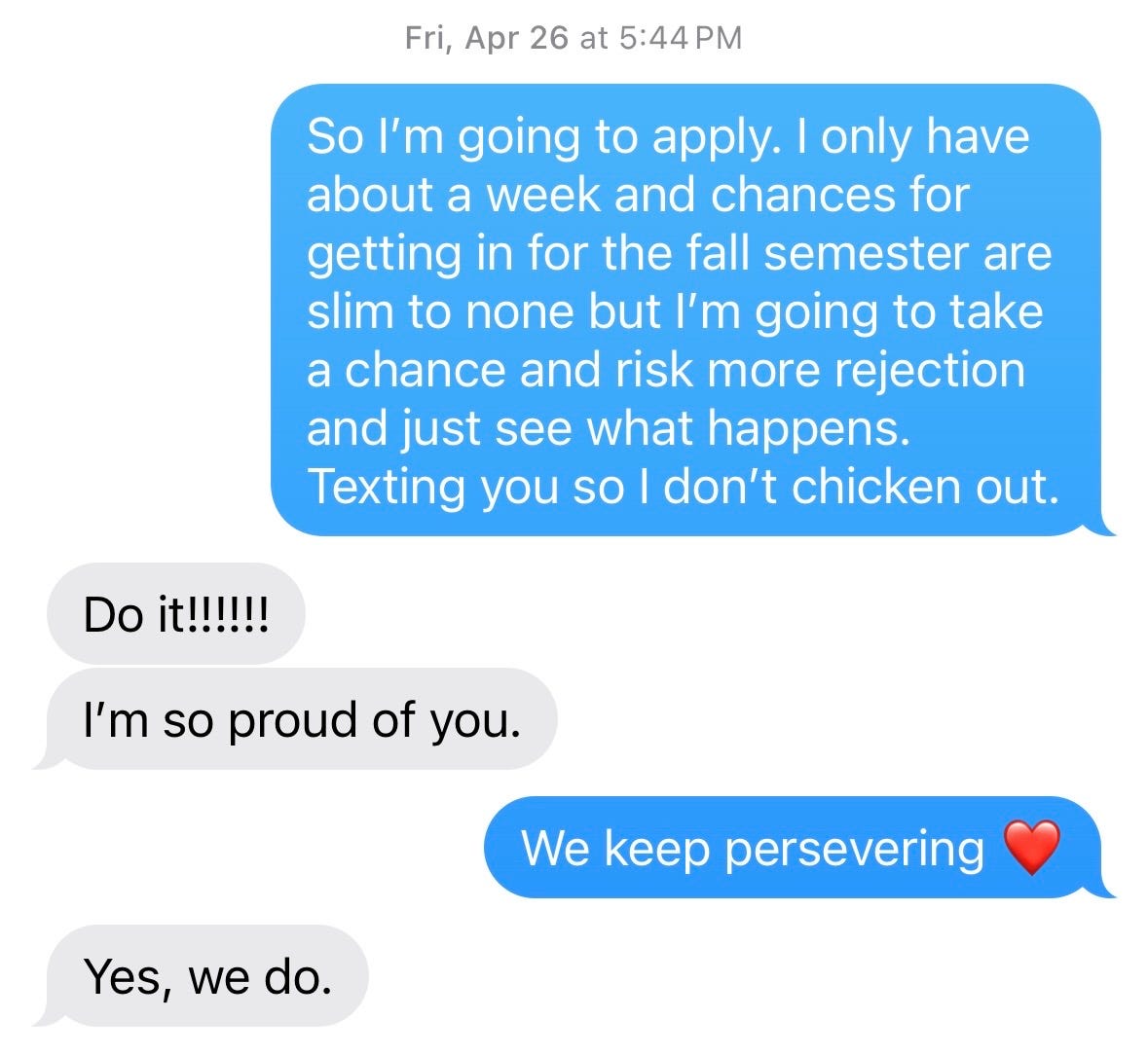
With just a week before the deadline, I wrote and revised a 30 page manuscript, polished my resume, reached out to one of my university professors for a letter of recommendation, and ordered my transcripts. The acceptance stunned me, especially as it came after years and years of personal and professional rejection.

In the months prior to submitting my application, my first book proposal had been sent out for submission and as the rejections trickled in and the responses echoed similar reasons for passing, I grew increasingly discouraged about next steps. But if I’m honest, a small part of me was also relieved. Because at the heart of everything, what I truly wanted was to grow in my craft. It was the reason I followed other writers, journeyed to Michigan, published on Substack. In words, I found potential, not just to convey a message, but to create beautiful movement and sound, to evoke deep feeling. I’d read seasoned authors and weep at the transcendence of their words, unsure even how to unpack the skill behind the page. I was increasingly drawn to essayists who wrote with intention, down to the blank spaces between braided sections, the mirrored first and last lines, the callbacks, the repetition. I was hungry for full immersion in a writing world.
I often see Threads posts and Substack notes about the damage of graduate-level workshops and unceasing critiques. I’ve heard horror stories of pretention and cruelty, a lack of hospitality in some of the most tender spaces when words are still raw and narratives often highly experimental. And I am sure that if my first experience with workshop had been like those, I wouldn’t have graduated. I probably would have ceased writing altogether. Because I am convinced that growth in any craft requires kind, hospitable critique. And that is what I have received for two years in dozens of letters and annotations and discussions. I won’t say it’s not difficult to sit silently as your professors and peers discuss their interactions with your hard-wrought words, sometimes quibble over meanings or preferences. I won’t say that I haven’t cried on the car rides home, still sensitive to the perceptions of others. But I will say that it has all been for my benefit. My peers and professors have been kind and necessarily critical in pushing, encouraging, questioning my drafts. My craft has grown beyond anything I thought possible. And in the process, I’ve found my voice.
A few weeks ago at an interview for a teaching job in San Diego, I was asked how engaging in writing workshops has influenced my teaching. From the very first day of tutor training, we were reminded that “writing is social.” Yes, we may spend a great deal of time alone at our desks, but good work will always require outside eyes. Workshops are incorporated into our curriculum for teaching ENG 1010—for every major assignment, students participate in small group workshops where they read one another’s work, fill out questionnaires, and discuss their responses with their peers. I understood the benefit of this model because I practiced it alongside them, moving from teacher to student throughout the week, grading student work and then transitioning to my thesis or workshop letters.
A few years ago when I began working on my book proposal, I felt rushed. I had just read Rick Rubin’s The Creative Act in which he talks about the brevity of ideas. He believes we only have so much time with an idea, that if we don’t do something with it, someone else will (similarly, Elizabeth Gilbert believes ideas transfer via kissing).1 My first inkling of a book idea straddled two places—attempting to be literary without technique and filling a progressive Christian writing industry hole. But the best thing that ever happened to my writing was the rejection by a very long list of Christian publishers. I was trying to write my way into community; I was trying to validate my work through publication.
Our program director’s catchphrase is that “everything is an essay” and after these two years studying the art of the essay, I’m inclined to agree. The birth of this form of writing arose from exploration and reflection. And indeed, every word I’ve written these last two years, whether painstaking or inspired, came from places of curiosity and consideration and a deep attention to the order of words. In his essay “Thank You, Esther Forbes,” George Saunders reflects on the power of purposeful prose through Esther Forbes, the author of Johnny Tremain.
He writes, “Forbes had fully invested herself in her sentences. She had made them her own, agreed to live or die by them, taken total responsibility for them. How had she done this? I didn’t know. But I do now: she revised them. She had abided long enough with each of them to push past the normal into what we might call the excessive-meaningful; had held the prose up to sufficient scrutiny to turn it into something iconic, something that sounded like her and only her.”2
I don’t think I realized how much joy (and angst) I find in scrutinizing my own sentences, abiding with my words until I finally figure out how they fit together. There is no rushing this type of ownership and responsibility. As Saunders writes, “This process takes time, and immersion in models of beautiful compression.”
In Big Magic, Elizabeth Gilbert writes about kissing Ann Patchett on the mouth and, thus, transferring the novel idea she’d been working on—so now I can’t help joking about kissing people for inspiration.
Highly recommend taking a few minutes to read the essay in full—I’ve reread it several times over the last few months and find it incredibly thoughtful and encouraging.
I remember you deciding to take the plunge after all those rejections. So glad you got this space to sit with the sentences. I’m so hopeful that Beautiful Discipleship Books will become a space for other writers to do the same.
I could not love you more, dear friend.